This is my blog on the Campaign for Records website which was published in May 2022
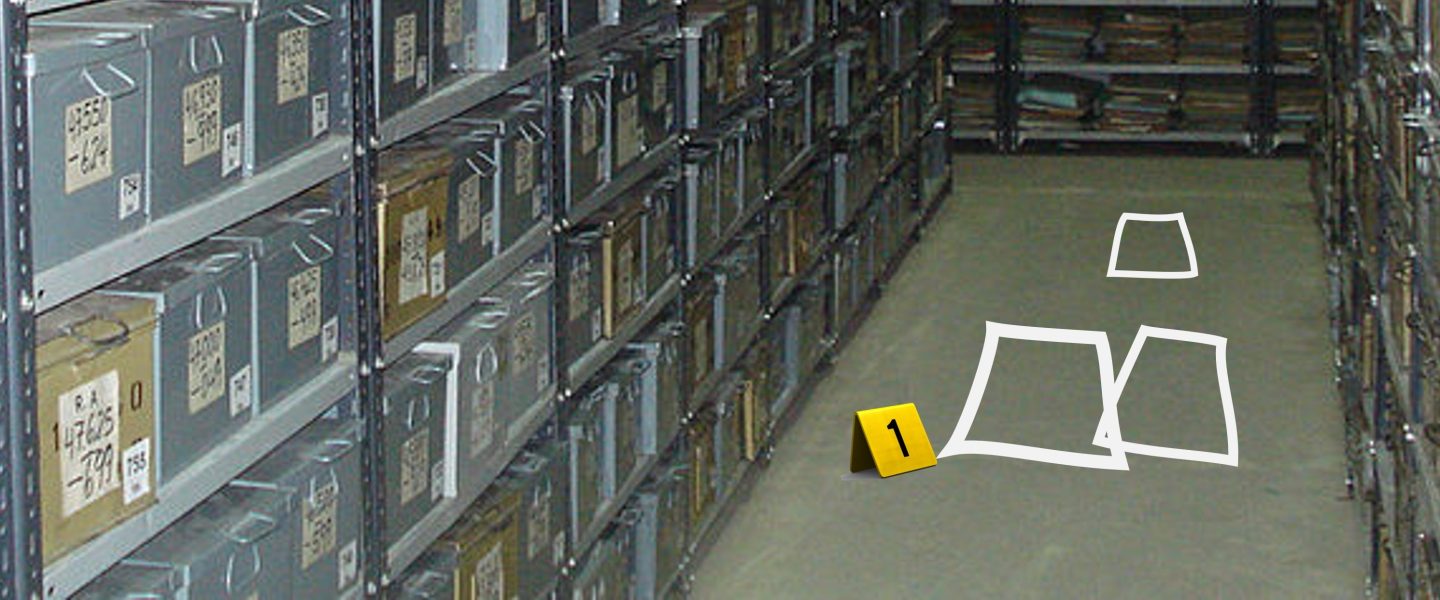
Police archive; image by Angie Sutton-Vane
My interest in police records began whilst working as the curator of a police force museum. The small and closed facility held a diverse collection including a large archive of general orders, station ledgers, personnel registers and some more challenging files relating to the investigation of serious crimes such as murder.
I’m not an archivist — my background is working with museum collections — but my interest was piqued when it dawned on me that most of this archive had come into the museum via informal means — and by informal I mean that it had not been transferred from the force’s records management system. Instead, they were private or individual donations from retired police officers, the relatives of officers who had since died or as the result of station closures and clear-outs when individual officers had taken an unofficial decision not to throw papers onto a skip. As a closed museum records were not accessible for research and the types of documents being preserved and the reasons for their preservation were extraordinarily haphazard. A number of discussions with the force’s records management department failed to change this; they – as with most police forces – adhered to guidance set out in the Management of Police Information (MoPI) which skimmed over the complex issue of archiving.
My time as the curator of this museum inspired my subsequent PhD thesis which employed the murder file as an exemplar to explore the often strange life cycles of regional police force records and the crucial roles of culture and memory (rather than any protocols) in determining what was eventually preserved. As I wrote I often stumbled down research rabbit holes: some I quickly climbed out of and skirted around, but one I was drawn into and continue to return to is the ongoing argument for making police records more accessible — not only for the growing discipline of policing history, but for the increasingly important dual requirements of accountability and transparency. Like government departments, police forces are publicly-funded, highly public facing organisations and upholders of the law who need to be able to clearly demonstrate principles such as integrity, accountability, openness and honesty — principles laid down in The seven principles of public life (or the Nolan principles). It’s difficult to understand how this can be achieved without access to records.
The Open University History Department (where I’m now a visiting fellow and consultant) has, for a number of years, been interested in the preservation of policing records. Part of the work of their Centre for the history of crime, policing and justice has been to participate in initiatives to press for the inclusion of police forces in the Public Records Act, a cause which was catapulted to the fore in the aftermath of the Hillsborough stadium disaster of 1989. Both the Report of the Hillsborough Independent Panel and the later report by Bishop James Jones recommended either inclusion of police records in the Public Records Act, or some other ‘appropriate solution,’ to ensure greater consistency and regulation around what police records were selected for preservation (and not the haphazard situation I had encountered).
Unlike Scotland, who not only revised their equivalent Public Records Act in 2011, but included Police Scotland in the new Act, or the Police Service of Northern Ireland who were included in the Northern Ireland version of the Public Records Act, in England and Wales there seems to be little appetite for such a move and it is increasingly unlikely that police records will become public records. Generally Hillsborough, as with many high profile disasters, has been the catalyst for campaigns towards greater accountability and this has included the drafting of the Public Authority (Accountability) Bill sponsored in 2017 by Andy Burnham — a Bill which has, as yet, to be passed by the current government (2022).
Conversely, returning to Bishop James Jones’ alternative ‘appropriate solution,’ positive moves have been made in drafting a new statutory code to replace MoPI which contains significantly more guidance (and therefore control) around the long-term preservation of police records. In terms of my personal research, I’d be interested to know how this will affect the future collection of the large tranches of records I identified above as informal deposits — I suspect they will dry up completely. Through collaborative research at the Open University, mapping of the current levels and status of police records held by county and city record offices has begun. Gathering such baseline data will enable us to assess whether the code will effectively increase the archiving of police records and the ability to access those records for any type of research — whether historical, journalistic, for policy implementation or public inquiries. Such information will contribute to wider and current debates around accountability, openness and integrity of all public-facing, publicly funded bodies and the symbiosis between this and the preservation of, and access to, records.
A number of histories of UK police forces begin right at the beginning of policing with rich information about parish constabularies, early reform and the establishment of the Metropolitan Police. For some, by the chronological ending of the book, information tends to get thinner or peter out. The reasons for this could be three-fold. First, that regional force histories were often written at the point of amalgamations instigated by either the 1964 Police Act or the 1972 Local Government Act, in order to preserve a perceived loss of history. Or they may have been written to mark other major landmark events such as force centenaries many of which occurred in the mid-20th century. Secondly, this, in turn, indirectly influenced the chronology of national histories – for example, T.A. Critchley acknowledges that he made use of ‘forty or so’ local police force histories.[1] The third reason feeds into a reliance on secondary material (published books) which may indicate a lack of primary material (original records). Again this is particularly pertinent for regional forces whose records have never been incorporated into the Public Records Act and consequently were less protected.
This, then, really forms the crux of my blog: whether writing about police history, history of crime, or wider criminal justice history, and whether under the umbrella of academia or personal research, it all relies on the ability to access primary material held in record offices or by police force museums. I’ve written about this now on a number of occasions, most notably in my PhD thesis, but I’ll continue to beat the drum because here in 2021 I feel there is an under-represented concern about the health of historical writing and the ability to be able to create a balanced, current and relevant history of policing in the UK. This blog, then, will set out to explore these challenges.
Recognition by police forces that their records have research and historical value
The Amazon page for The English Police by Clive Emsley provides a clue to the first of these challenges in describing the book as: “A comprehensive history of policing from the eighteenth century onwards, which draws on largely unused police archives ….”[2] Professor Emsley, as the doyen of policing history, undoubtedly had the necessary contacts to access those largely unused police archives. He also had insider knowledge in that in 1989 he and Dr Ian Bridgeman published their comprehensive survey of archival material held by police forces in force museums, archives, cupboards, store rooms or in offices at headquarters.
One outcome of Bridgeman and Emsley’s survey was L.A. Waters’ Towards a records management policy for provincial forces in England and Wales which was published by the Police History Society in 1992 and circulated to all UK police forces.[3] It was hoped this would at least draw attention to the plight of many of the records identified by Bridgeman and Emsley and provide a simple guide to assist forces in recognising and archiving valuable historical material. In 2003, Emsley and Dr Chris Williams sent out a survey to UK police forces in order to ascertain whether the guide had improved the situation. The responses to this survey identified one key problem which remains relevant today: only ten per cent of responding forces appreciated what sort of material was of future historic value with many archiving ‘a narrowly defined and static group of “historical” records.’[4]
The flow of records from police forces into the public domain
To an extent, Bridgeman and Emsley’s 1989 survey only told half the story because it didn’t touch on what police records were already sitting in the public domain in record offices. With finite funding and time and limited to just six record offices, my PhD research at least offered a glimpse of this missing narrative. By conducting surveys of online catalogues, corroborated with more direct contact with archivists, it showed that all six archives received large collections of policing records between the 1940s to 1980s. However, post 1980s there was a drop in all cases to near zero deposits being made by those same forces today. The surveys also revealed some important pointers around why police force records were entering the public domain:
Just over fifty per cent of the records currently held by archives could be described as ‘informal deposits’ in that they were presented to the record office by retired police officers, families of police officers, individual officers acting on their own initiative rather than any force agreed deposit.
Included in this were significant quantities from closing force museums;
Large quantities of records were deposited with record offices during periods of amalgamation as a result of closing station and department clear-outs, but also perhaps triggered by more emotional responses of removing material from the perceived subsuming force.
Much of the later material – post 1980 – tends to be of a more curated nature: annual reports, newsletters, photographs, histories of the force; this again reflects not only a lack of understanding around what is important to preserve, but insecurity around what can safely be preserved.
More recently some police forces have removed collections from their local record office – notably Cumbria and Surrey police forces.
The reasons for the demise of historical police records entering the public domain is complex: of course computerisation and a reduction in paperwork needs to be viewed as a major contributor. But legislation such as Freedom of Information and Data Protection (GDPR) and PACE have all led forces to apply additional layers of control over their records and to view them as ‘high risk.’
One clear contributor has been the Management of Police Information (MoPI) which by narrowly defining and closely adhering to the DPA, FOIA and other legislation and policing protocols, has overshadowed and neglected the historical importance of the UK police.
The future of policing histories
Writing history is a complex balance of processes which involves access to a good range of primary material and the ability to interpret the material that is presented: who selected it; why is it there; what are the voices that are not represented? The section above clearly illustrates that what is selected is often tempered by emotional responses or control. The intellectual landscape of deposits is changing: layers of acts and policies not only started to plug the leaking fifty per cent of records flowing unofficially out of police forces and into the public domain, but reassessed the remaining fifty per cent.
As a good news story to end on: with work from the Home Office, the College of Policing and a number of key advisors, MoPI is being redrafted as a new Code. Perhaps the long beating of the drum has finally been heard because it will now have a greater emphasis around archiving records which is hugely welcomed. However, there are two critical points to monitor: first will this create greater access to records for researchers – and without access there is no history? Second, if it does encourage forces to archive more material, what sort of material will be preserved? It takes skill and courage to select representational cross sections which tell the entire story and whether forces have the expertise or resources to do this only time will tell.
Notes and further reading:
There are some recent and great success stories of important policing collections being deposited with local record offices, for example, Northamptonshire and Devon & Cornwall and it is hoped this trend will continue in the light of the new code. I would also like to recognise all those force museums who often work in difficult circumstances and yet provide excellent research facilities.
The National Police Chiefs’ Council have recently launched a Heritage Portfolio with the aim of supporting and protecting policing heritage
Bridgeman, Ian and Clive Emsley, A guide to the archives of the police forces of England and Wales (The Police History Society, 1989) (available here)
Sutton-Vane, Angela (2021) Investigating the murder file: A biographical analysis of creation, survival and impact (PhD thesis: The Open University) (available here)
Willlams, C.A. (ed) Giving the past a future: Preserving the heritage of the UK’s criminal justice system (London: Francis Boutle Publishers, 2004)
[1] For example Critchley cites histories of Swansea, Anglesey, Kent, Leeds and Cheshire Constabularies. T.A. Critchley, A history of police in England and Wales: 900-1966 (London: Constable & Co. Ltd, 1967), pp.xviii-xix
[2] Emsley, Clive, The English police: A political and social history (Harlow: Addison Wesley Longman, 1996)
[3] Waters, L.A. Towards a records management policy for provincial forces in England and Wales (Police History Society, 1992) (available from the Police History Society)
[4] Williams, Chris A. and Clive Emsley, Police records archiving policy in Great Britain: interim report, The International Centre for the History of Crime, Policing and Justice (Milton Keynes: The Open University, 2003)
Images: Header image: Metal boxes on the shelves of the AySA archives (image in the public domain); File: East Sussex Record Office, R v Field and Gray, 1920, SPA 10/51/1; Graph: showing opening and closing dates of police records held at Cheshire Archives & Local Studies, created by Angie Sutton-Vane.
This is the story of a little known house with a big and forgotten history in the North of Wales.
Plas yn Bwl House is a Grade II* building located in a prominent location overlooking the historic Welsh village of Caergwrle in Flintshire. It is adjacent to the medieval castle and has far-reaching views to what were once the important medieval fisheries and mills of the Dee Estuary and the Wirral to the North. The ancient palatinate state of Chester is 11 miles to the North East.
To all intents and purposes from the front it looks like an early Victorian sandstone house with large sash windows and thick Welsh slates on the steep roof. The only clue is that lovely humped ridge hiding the crooked ancient oak trusses beneath. At the back, however, it nestles deep into the hillside and an ancient landscape of meadows, streams, ponds and dry-stone walls. From here it can be better understood: a square tower houses a stunning stone spiral staircase, and the massive scars of walls that once continued out to form a medieval hall with solarabove are still visible.
We bought Plas yn Bwl in 2018 – a forgotten and neglected piece of history – and have spent 6 years resurrecting both its narrative and fabric. In 2023, with the support of Clwd-Powys Archaeological Trust, we revealed the entire extent of the medieval hall, which had remained buried and undiscovered for many hundreds of years. You can view the photogrammetry here.
With its square tower, stone spiral staircase with remnants of ironmongery for heavy fortified doors, it is possible that we are caring for the remains of a rare Welsh tower house or fortified manor, a theory made more likely when the history of the house is understood.
The Tower, Nercyws, near Mold, Wales
The tower at Gwydir Castle, Llanrwst, Wales
The earliest reference to the house appears in P.C. Bartrum’s Welsh genealogies. An online version of his family trees can be found at FamilySearch and entries on this suggest that the house dates from the 1350s. However, others including Cadw – the Welsh body responsible for listing heritage sites – describe it as late medieval. What is certain is that it formed part of one of the estates of the Boldes, Bowldes or de Boldes. The de Boldes were a family of knights with their ancestral roots stretching back to the 1100s and their ancestral seat at Bold Hall in Lancashire. In earlier references to the house it is called Plas y Bowld – the mansion of the Boldes – and the name probably mutated to Bwl as a result of a misunderstanding when in 1699 it was described by Edward Lhwyd in Part I of Parochialia as Plas yn Bwl ‘belonging to ye Bulls.’ (p.96) No Bulls have been identified.
What has become increasingly clear during research is that Plas yn Bwl did not start life as a Welsh gentleman’s house, and that the Boldes were a family intrinsically linked with the repression of the Welsh and the Marcher lordship system and this is the reason for its semi-fortified status with metre thick stone walls and a tower – it was potentially to protect the family from the Welsh. The Boldes had close connections with the powerful Stanley family, later the Earls of Derby, and by 1401 Sir John Stanley was granted the Marcher lordship of Hopedale by Henry IV. Hopedale incorporated the medieval villages of Hope and Queen’s Hope with its castle, later Caergwrle, so this was undoubtedly the catalyst for the Boldes’ presence in the village. By 1403 Sir John and Thomas de Bolde were fighting as Lord Stanley’s knights to combat the uprising of Owain Glyn Dŵr. Later, perhaps rewarded for their loyalty, the two brothers or half-brothers, were serving as Constables of Conwy and Chester castles respectively.
Plaque dedicated to Owain Glyn Dŵr in Yr Hôb or Hope, Flintshire
It appears Plas yn Bwl fell on hard times and went into decline. It is possible that from the late 1400s the Earls of Derby and the Boldes attentions were distracted by the Wars of the Roses, and certainly by 1536 the Act of Union which incorporated Wales into England also abolished the Marcher lordship system. According to Bartrum and also Jacob Youde William Lloyd (Vol III, pp.36-37) around 1430 an heiress, Janet Bolde, had inherited the house and with her marriage to Jeffrey Whitford or Chwitfford, ownership left the Boldes. Later, with another heiress, Margred Chwitfford, marrying into the Griffiths of nearby Brymbo Hall, the house was subsumed into the estates of the Griffiths. By 1699, when Lhwyd described the house, it was owned by the Yonge family of the nearby Bryn Iorcyn estate and remained a part of this estate up to the early 20th century.
Plas yn Bwl has remained unassuming and silent, quietly sinking into its landscape over the centuries. Although it has no voice, it has found its way into two images from 1742 and 1795.
The North West view of Caergwrley Castle in the County of Flint by Samuel Buck, 1742, National Library of Wales
Detail
South aspect of Caergwrle Castle by John Ingleby, circa 1795, National Library of Wales
Detail
The castle today taken from same spot as 1795 print with position of Plas yn Bwl in foreground and Bryn Iorcyn Manor beyond
1795 print overlaid
As Bryn Iorcyn also declined in status, with absentee landlords and tenant farmers, it seems by the early 19th century Plas yn Bwl had fallen into such a state of disrepair that it was rebuilt as a row of six workers cottages, reflected in the 1850 tithe map and in the national census’ for 1851, 1861, and 1901.Thankfully, some early features survived such as the stone spiral staircase now impossibly worn by centuries of feet – and going nowhere, the main chimney and fireplace and door arches. Outside the ruins of the medieval hall were buried and forgotten.
The house remained as a row of tenanted cottages occupied by farm workers, coalminers etc, but by the 1960s or 1970s the four adjoining cottages were derelict and with the surviving remains of the medieval house potentially at risk it was listed in 1962 as Grade II*.
Grave stone in Hope churchyard: ‘In memory of Mary Evans, wife of Thomas Evans of PlasynBull who departed this life June [?] 1830 aged 40. Also Elizabeth daughter of the above who died Nov 12th 1821 aged 1 year. Also Robert son of the above who died [….]’
Plas yn Bwl circa 1900 reimagined as a row of 6 estate / workers cottages. Image shared on Facebook, source unknown
View of Bryn Yorkin Lane, Caergwrle, with Plas yn Bwl at top circa 1900. From shared photocopy, source unknown
A bleak image circa 1940; the cottages are now in poor repair. Note the arches appearing through the whitewash – were they converted from an earlier barn? Source unknown – shared on Facebook.
The rear of Plas yn Bwl; circa early 1960. Was this taken at the time of the house listing? Note the cottages are still there, but the house is semi ruinous. Image from North East Wales Archives; Cat No: PH/12/43
The rear of Plas yn Bwl from the footpath; circa early 1960. Image from North East Wales Archives; Cat No: PH/12/42;
The stunning blocked up doorway on the East face. Evidence of earlier archway above. Detail later covered in cement render to be uncovered by us. Photo circa early 1960 from North East Wales Archives; Cat No: PH-12-0041
Plas yn Bwl circa 1970. The row of whitewashed cottages are now derelict and were demolished shortly afterwards. Source unknown: shared on Facebook.
By the late 1970s, despite being part of the curtilage of the main house, the four cottages were demolished and the area to the side and in front of the house redeveloped as a small estate of houses. At around the same time the family who then owned the main house (the two surviving cottages) were given a council grant to rectify what were undoubtedly sub-standard living conditions. Sadly, during this process flagstone floors, hearths and ranges were removed, a new concrete floor with a plastic damp proof membrane was laid throughout and all internal walls were given a thick coat of cement render.
We have been custodians of Plas yn Bwl House for six precious years. During our stay we’ve reconsolidated the house as one, repaired the roof and chimneys, replaced rotten lintels, repointed with lime, stripped out all the cement render from the internal walls, had new sash and casement windows made, opened up the main fireplace and installed a multifuel burner, sourced flags for the floors and much more. We’ve worked with the local conservation officer, a conservation architect, architectural historian and archaeologist to reinterpret the house and place it back in its historical landscape. We hope our interventions and love have stopped the decline and fall and will begin its rise as the important house it once was.
Plas yn Bwl House is now for sale at auction – you can find it here. We would love its next custodians to have the empathy and vision to continue the journey we began.
The fireplace before inglenook was found
Lining the chimney in preparation for installing the burner
Discovering the medieval hall walls at the back of the house – buried
Digging out the medieval wall
Working with the archaeologist to dig out the medieval hall walls
Archaeologist
Llay Hall brick
Concrete tiles removed from kitchen roof
Rotten roof timbers by parapet wall
Replacing coping stones
Old iron nail from roof
Work on the rotten roof valley replacing with reclaimed oak
Roof topping out
Lead detail under coping stones to stop water ingress
Old wooden pegs from roof
Newly planted copper beech
Second year of Butterbur planted in the field
Living room in cottage 1 at purchase – no sign of the inglenook or bread oven
At the salvage yard again – looking for York flags for inglenook
Fireplace revealed with multifuel burner installed and new flags
Removing cement render from stone walls
At the salvage yard – choosing reclaimed flags
New engineered brackets to support living room beams – painted and drying
Removing a toad from the house!
Kitchen at point of purchase
Kitchen arch boxed in, tiled and painted
Quarry tiles in kitchen under vinyl
Boxing in and tiles removed from kitchen archway
Lowering old water tank from kitchen roof
Emerging from a place of comfort during building work
Uncovering arch detail in door between kitchen and living room
Fish pie
Early blocked up window in back stairs
Second back kitchen
Spiral staircase at point of purchase
Spiral staircase at point of purchase
Removing the cement render from the spiral staircase
Removing the cement render from the spiral staircase
Evidence of door bars on spiral staircase
Downstairs bedroom / dairy at point of purchase
Opening up upstairs door between two cottages
Opening up downstairs door between two cottages
Main bedroom at point of purchase
Attic or cluster fly infestations
Sooo cold in the study …
Striping out the back shower room and installing drainage
Damp penetrating through the cement render
Removing artex from the shower room ceiling
Apple from the Cats Head tree
Dug up in field
Damson jam
Clearing out the pigeon lofts
Another hard day
Bunk complete with heated blanket
Damson crop
Another year of laden damson tree
Samples of reconstituted flag stones – much cheaper but not allowed
Wood pigeon and red wine gravy
Amazing poo!! We have a hedgehog
Mother duck and ducklings appear in the garden one morning
A day off at Talacre Beach
Snaxident
Thinking about the floors – lovely but too expensive!
Game pie!
Help with the PhD thesis writing
Arrival of reclaimed thick Welsh slates from an old hospital in South Wales
Damson and quince gin
Chicken in the slow cooker
Dairy and gluten free lasagne
A day off a Ness Botanical Gardens
Chowder!
Accoya casement and sash windows being made in Yorkshire
Accoya casement and sash windows being made in Yorkshire
Slate sizes
Parasol mushroom
Shelter from the rain under the crooked apple tree
Above is a screenshot of my post at The Conversation. Below is a fuller and earlier version:
A few weeks ago I made a long-anticipated pilgrimage to The Museum of London to visit The Crime Museum Uncovered; anticipated because, for the last 11 years I have curated another police museum, and the dilemmas of keeping and displaying contentious artefacts and documents interests me; in addition I am a PhD student at the Open University examining the material culture of police archives.
Tourism gone dark
Tourism is defined as dark when it involves visiting sites associated with death, disaster and tragedy “for remembrance, education or entertainment” (Lennon and Foley, 2000). It isn’t hard to find examples of independent museums who make no bones about exploiting their darker sides. Just think of The Clink or The London Dungeon. But the outrage over the recently opened Jack the Ripper Museum in London (also see my earlier blog on the Jack the Ripper Museum) shows how controversial dark tourism can be and how easy it is to get wrong. This museum clearly intended to target particular visitors, and ignored the fact that the subject is much more complex, including a number of important concerns around womens’ rights, poverty and crime. As a small, ill-informed enterprise they crossed ethical boundaries.
These grey boundaries mean that the brand of dark tourism is something that the partners of this latest exhibition (The Museum of London, The Metropolitan Police Service and The Mayor’s Office for Policing and Crime) have tried to distance themselves from. It’s obvious that they are anxious to avoid allowing visitors to unashamedly gawp at cabinets of curiosities and to ensure minds are correctly channelled. They do so by safely anchoring the exhibition around academic themes such as museology and historiography, and by linking each of the 24 cases featured to developments in crime detection or law. They are also keen to emphasise the need for discretion and respect for the victims: they exhibit no individual cases post 1975 and, as part of the ethical process of selection and in compliance with the Human Tissues Act 2004, they display no human remains. The police’s messages and outcomes are not as transparent. Undoubtedly it has been a huge public relations opportunity to celebrate their role in keeping the streets of London safe. In addition, however, remembrance is important and the display of a burnt riot shield from the Broadwater Farm riots of 1985 not only provides a far too small platform for contested histories, but also an opportunity for the police to remember and to remind the public of their fallen colleague, PC Keith Blakelock.
So, I asked myself as I sat in front of the panel about the Kray twins: what does a dark tourist look like? I considered the party of white-haired ladies who gathered in hushed discussion and who could, for all intents and purposes, have been Womens’ Institute members tutting over a disastrous sponge cake. The Kray twins were strange celebrity/gangster hybrids whose glamorous nightclubs served as portals through which the rich and famous were able to briefly pass, tasting a parallel world on the “other side of the law”. A form of reality dark tourism, perhaps?
The original Crime Museum did something similar. Based in New Scotland Yard’s notorious Room 101, it indeed housed some truly horrific items and, because it was never intended to be a “museum”, but rather a training resource, it had no boundaries around ethics. The small space created a melting pot where men in shiny, squeaky shoes and creased trousers rubbed shoulders with celebrities, politicians, historians and potential criminals (in the visitors’ book for 1905 is the signature of Frederick Seddon, who later murdered Eliza Barrow).
In the past, dark tourism was everywhere. Now it’s tainted, something that major museums are keen to distance themselves from: modernity has separated us from the daily immediacy of death. Yet we still have a basic human desire to understand the incomprehensible and to push at our own ethical boundaries. As such, all museums play an important role in education, remembrance and entertainment and most hold numerous artefacts relating to death in some way. How many millions of visitors have stared at the grotesquely distorted figure of Lindow Man in the British Museum? Or the human-shaped voids at Pompeii frozen forever in the act of dying? Do such displays fall into the dark tourism net?
So the dilemmas, particularly for museums of crime, are around how to manage the boundaries between entertainment and the perception of profiting at the expense of others pain. Profit, though not touched upon in this exhibition or supporting material, can’t have been far from the Metropolitan Police’s mind: with the sale of New Scotland Yard and with massive cuts across all police forces this small museum is not a key aim or objective of the police and needs to earn its keep. In August 2013 the Express posited a similar thought: “If entrance was charged at £15, the exhibition could look to bring in up to £4.5m” (adult entrance is £12.50).
Despite this pecuniary background, correctly managed, dark tourism is actually quite light at the edges. When emphasis is placed on remembrance and education it is a healthy part of building on our life experiences and the term should not be shied away from. It’s important to engage with and talk about our fascination with death.
Some further reading: Lennon, J. and Foley, M. (2000) Dark tourism: the attraction of death and disaster, London and New York: Continuum
Rogers, N. (2002) Halloween: from pagan ritual to party night, Oxford University Press
Walby, K. (2011) “The polysemy of punishment memorialisation: dark tourism and Ontario’s penal history museums”, Punishment and Society, vol. 13, No. 4, 451-475
Keily, J. and Hoffbrand, J. (2015) The Crime Museum uncovered: inside Scotland Yard’s Special Collection, I.B. Tauris
I enjoy writing these blogs – I hope you enjoy reading them; please do share or comment!
I have been following the debate around the opening of the new Jack the Ripper Museum at 12 Cable Street, London both on the Museum Association’s LinkedIn pages, and also via the press who have interviewed irate support groups and local communities. Yet I can’t help reflecting that the man at the root of it all – Mark Palmer-Edgecumbe – will be all too familiar with the fact that “bad publicity is good publicity”; his new venture has certainly hit the headlines in a way which would have otherwise cost a fortune to organise, and this morning the website viewing figures were at 17,973. If he can weather this big storm (and I understand the opening of the museum has been delayed) he may well have a viable business to take forward.
So I consider, as I sit at my desk on this rainy Tuesday morning, whether some of this public outcry is around the discomfort of admitting that “Ripperology” is big money – a fact which has surely not gone over Mr Palmer-Edgecumbe’s head. Not far from the new museum Jack the Ripper Tours advertise their latest technology: “the gruesome tale of Jack the Ripper explodes for the first time into the 21st century … WITH RIPPER-VISION“. 12 Cable Street was marketed at £500,000 as an excellent development opportunity. Even with a total boycott from the local community and world of museums, at £12.00 entry fee and the online Ripper shop they may achieve a healthy profit by targeting the niche dark tourism sites and the curious tourists who crave a London of pea soup fogs and Sherlock Holmes murders. And who am I to point a finger here – all heritage attractions are now chained to “sustainability” and business planning. In academia dark tourism and histories have been widely researched, but where academics may venture in, museums or heritage attractions need to tread a fine line between “good” and “bad” taste and address the hard to define issues of decency, respect and ethics. Indeed, Paul Mullins comments in his post on Archaeology and Material Culture website that “the Jack the Ripper Museum is firmly situated in this ambiguous tension between measured museum scholarship and tourist trap sensationalism”.
Having worked as a curator for a police museum for over 10 years, acted as Arts Council England mentor for another police museum, as well as currently sitting on the committee of the Crime and Punishment Collections Network and researching an AHRC-funded PhD examining police collections, I constantly skirt around the boundaries of dark tourism and contested histories. I am used to the fact that murder creates huge interest, whether from the salacious, the writers and readers of true crime or the historians of criminology; and I am equally aware of the sensitivities and ethics of holding artefacts and files which record sudden deaths in violent and often unexplained circumstances, in respecting the voices of the dead and, for more recent murder cases, the wishes of the families. Often police files, forensic evidence and morgue photographs are all that the victims’ families have left. Murder wreaks havoc through families for generations and I have occasionally had to work with relatives or descendants trying to piece together the guilt, the sorrow and the silence. Police, Prison and Court Museums are dotted around the country displaying artefacts and historic archives for the organisations they represent. Indeed 30 minutes walk away is the City of London Police Museum which holds its own collection relating to Jack the Ripper including photographs and information about the investigation and also – though much less publicised – the Houndsditch Murders of 1910 which led to the Siege of Sidney Street (there is a post about it on The History Student’s blog). You won’t find portrayals of the dripping blood of women at this modest museum because it’s all to do with professionalism and public money.
It seems that this year is the year of criminal heritage. The fantastic Forensics exhibition at the Wellcome Collection was, I felt, a triumph in the public examination of the science of solving murders. They certainly recognised and commemorated the lost lives with an important part of the exhibition devoted to artists’ interpretations of crime scenes as sites of memory. It cannot have gone unnoticed that the Museum of London will also be venturing into the world of dark histories when they host the first public viewing of the “Black Museum” from New Scotland Yard – a collection I have been privileged to visit on a number of occasions. And this will indeed be a huge challenge because its very inaccessibility and nickname of the “Black Museum” (in that it was never intended for public view but as a training resource for detectives and officers) has created an aura of notoriety – below are some excerpts from the exhibition website:
“Giving voice to the real people – victims, perpetrators and police officers – behind these objects we’ll explore the impact of crime, personalising what is so often depersonalised. Confronting how, as a society, we respond when normality is shattered and lives are torn apart, we’ll also be forced to question our enduring fascination with this hidden collection and its stories”
and
“The exhibition is designed for an adult audience. It includes: objects, films and photographs relating to real criminal cases. These include cases of violence, murder and terrorism, as well as smaller exhibits on abortion, drugs (including drugs paraphernalia) and capital punishment. The objects are largely evidence from the cases and are directly linked to and were used in the crimes or their investigation. The films are mainly footage of press reporting of the cases. Examples of weapons, including firearms, knives and concealed and home-made weapons”
With first hand experience of interpreting police collections, I believe the Museum of London will pull this off. They have access to the necessary expertise and resources, as well as a wealth of experience in displaying archaeological remains and burial sites.
So how has someone with Mark Palmer-Edgecumbe’s pedigree apparently got it so wrong? Especially as it seems (according to an article in The Londonist who interviewed him on 31st July 2015) he was a Governor at the Museum of London from 2005 to 2013, Chairman of the Museum of London Docklands from 2006 to 2009 and former Head of Diversity and Inclusion for Google in the UK, Middle East and Africa. In addition (again according to The Londonist) Dr Cathy Ross, author and honorary research fellow at The Museum of London, acted as curatorial consultant and wrote a guide book. There seems to be a chronic lack of transparency and like some dark magician Mr Palmer-Edgecumbe appears to have duped his entire audience into believing this was going to be a museum for women’s history and no-one was any the wiser until the scaffolding and hoardings were taken down to reveal all. Building Design Online interviewed Andrew Waugh of Waugh Thistle Architects who were commissioned by Mr Palmer-Edgecumbe to undertake the complex task of turning the narrow and cramped town house at 12 Cable Street into a fully functioning museum. Mr Waugh is another individual who feels duped over the project and that he wouldn’t have touched it with a barge pole had he known the eventual outcomes. He described how he was persuaded that the project had no money: “this was a real heart-felt project. It is incredibly important to celebrate women in politics in the East End. We really ran with it … we did it at a bargain-basement fee …. we submitted it for planning and never heard another thing … when we heard it was going to be turned into a Jack the Ripper Museum we contacted the owner but got nothing back, we heard nothing.” And so the façade adorns Cable Street complete with dripping blood, skull-and-cross-bones and fake English Heritage blue plaques commemorating suspected culprit George Chapman and the fourth victim, Elizabeth Stride. A rushed retrospective planning consent application (see the image at the bottom of this page) to make good and appease his critics now includes signage for “Jack the Ripper Museum and the History of Women in the East End” – how can the two even sit side by side? And so Mr Palmer-Edgecumbe digs himself yet deeper into this tangled, duplicitous and contradictory venture.
He may well have been inspired by The Sherlock Holmes Museum in Baker Street; a strange phenomenon in that many visitors truly believe it is a real place – a 3-dimensional site where fantasy is acted out. And this must also be a relevant and critical concern for any serious curator of The Jack the Ripper Museum. As has been pointed out by so many, it isn’t a ripping murder mystery but a grim sequence of events relating to deaths, women’s rights, poverty, violence and urban decay which sliced through the community at the time and continues to slice through the contemporary, rapidly evolving communities who are keen to celebrate all aspects of their rich heritage and contested histories “beyond” Jack the Ripper. It does seem, according to the media at least, that there is not just anger, but also a real tiredness around the relentless exploitation of this part of London; for example, The Guardian’s “How the Jack the Ripper industry distorts London’s East End” and the Independent’s “Are Jack the Ripper tours blighting London?“. I suspect much of this has to do with the rapid gentrification of these areas and that Mr Palmer-Edgecumbe’s venture is simply the straw that broke the camel’s back. As more savvy and settled middle-class communities move in and replace the traditionally transient populations there will be more and more raised voices about the environment in which they live.
My final thoughts before I close this post are – I just can’t help feeling, like any good trick, that there must have been more going on behind the scenes than certainly I am led to believe. Surely any heritage project which involves a number of interested parties should be allowing access not only to the physical site but to the changing vision – because visions areamorphous by their nature.And with this in mind, I would like to know whether the press, or anyone, has been given a private viewing of the completed interior so that we can all at least make an informed judgement about the “book” rather than just the “cover”. It makes me wonder whether Dr Cathy Ross has made a valiant attempt to interpret a poisoned chalice of a project, and the disastrous facade was left to the whims of Mr Palmer-Edgecumbe.
Thank you for taking the time to read this post. I enjoyed writing it – I hope you enjoyed reading it. Please comment, share or like.
I felt a little out of my depths, but I went with the intention of increasing my understanding of patterns of thefts, hoarding and the lifecycles of books and documents which have become “objects of desire”. What hadn’t been an intention was that it would prompt me to consider a phenomenon which was touched on at a Material Witnessworkshop I had attended at Lambeth Palace Library a couple of months before (on the material culture of libraries) and also at the British Museums’ Working with Museum Archives workshop (see my earlier post). As the day unfolded I hastily scribbled in my note book “like a fox in the hen house”, but this analogy is already out there – indeed the paintingFox in a chicken yardby Jean-Baptiste Huet was later shown by a speaker. My note was referring to the emergent pattern of thefts from libraries by internal and trusted members of staff; extraordinary tales not just in terms of the criminal act and detection, but in terms of the gaping intellectual and physical holes left behind and the terrible loss of trust. Returning again to my blog on the British Museum, it is also around the psyche of the act; the sheer shameless audacity of these often quiet, highly respected individuals who were desecrating their own collections.
In no particular order, here are some brief, often bizarre accounts of the cases discussed during the day – plus a few others that I have come across:
The Royal Library, Copenhagen, Denmark In September 2003 the Royal Library received a phone call from a book specialist at Christie’s in London who had been instructed to sell a rare copy of a 1517 Italian book. Her pre-auction investigation had established that only two copies of this book were known to exist – one incomplete copy in the National Library of Spain, and one complete copy in The Royal Library in Copenhagen. This puzzled her – had she taken receipt of a historic sensation or a stolen book? The Royal Library informed her that the book was indeed theirs and had been recorded as missing from the collections since February 1979 during an audit process instigated by the library’s new security board – a board set up in response to the loss of a number of rare books from their foreign collections. At the time the police were notified and discrete enquiries were made; however, for thirty years neither the thief nor the books could be traced. Although it was established that the book was stolen, Christies continued to protect the seller’s identity until they were finally over-ruled by a court order, and the trail led the Danish Police to a woman called Silke Albrecht. She lived with a man called Thomas Møller-Kristensen – a surname familiar to the library. Frede Møller-Kristensen had been employed by them from 1967 to 2000; indeed from 1969 to 1987 he had been Head of the Oriental Department. Although Frede Møller-Kristensen had retired from the library in 2000 and died in January 2003, he had a son called Thomas and Thomas had married Silke Albrecht. Approximately 1,500 rare books from the library were found in the home of Frede Møller-Kristensen’s widow; another five rare books were found at Silke and Thomas’ home and a further four at the home of Silke’s mother. In May 2004 four people were sentenced. Christies returned a total of 16 rare books to the library.
The looted Girolamini; image from the BBC’s news site
The Girolamini Library, Naples; founded in 1586 In 2011 Marino Massimo De Caro, a self-taught bibliophile, was appointed as the new director of the library. Although the library had been closed for a number of years, hearing rumours that it was in trouble, Professor Tomaso Montanari secured a visit in the spring of 2012. He was shocked by what he found: “there was a dog roaming around the library with a bone in its mouth! There were books spread around everywhere – on the floor, on the stairs, on tables. There was garbage – soda cans and papers – on the floor. It was total confusion, a situation of major decay“. During his visit a member of staff confided to him that the Director was stealing from the library. Professor Montanari wrote an article for the Il Fatto Quotidiano newspaper in which he stated that having De Caro as librarian was like “having an arsonist in charge of a forest“. The day the article was published, De Caro contacted Professor Montanari and threatened him – Montanari called the police. The library was closed by the Public Prosecutor, De Caro was suspended and subsequently 1,000 rare books were found at his home in Verona – he claimed that he had intended to sell them to raise money to maintain the library. It became evident that De Caro had also plundered other libraries in Italy including Montecassino, Naples Municipal Library, Ministry of Agriculture Library, a seminary in Padua and the Ximines Observatory Library in Florence. It is believed that he may have been responsible for the theft of 4,000 rare books – some have since been recovered in Munich, London, New York and Tokyo. In 2013 German police arrested a book dealer in Munich, Herbert Schauer of the auction house, Zisska & Schauer on charges of complicity in receiving and offering at auction 543 books from the Girolamini. Schauer was extradited to Italy and sentenced to 5 years in prison; the auction house renamed itself Zisska & Lacher. De Caro was sentenced to 7 years in prison; 13 other people were accused of conspiracy included the library curator.
The National Library of Sweden, Stockholm Losses from the Royal Library came to light in 2005 when a request to view an early map revealed it was missing. A low-profile investigation was commenced during which a further 56 rare books were identified as missing; in addition it was found that records had been altered to try to conceal the thefts. Suspicions turned to Anders Burius, the Chief of the Royal Library’s Manuscript Department, who was the only person with the necessary level of access. Burius had been appointed in 1995; his flamboyant life-style and love of Armani suits, Cuban cigars and Mercedes Benzes had not gone unnoticed by staff. Confronted by management, Buriusconfessed to having stolen 62 rare books over a period of ten years. Burius was arrested, but upon his temporary release from custody committed suicide by severing the gas line to his kitchen stove, which then ignited and caused a major explosion in the centre of Stockholm. The investigation of the theft revealed that Burius, having removed all obvious marks from the books, consigned or sold them to Ketterer Kunst, an auction house in Germany, using the alias of Charles Fields of Denmark. His contact at Ketterer, Christoph Calaminus, checked neither his identity nor the books’ provenance, and all transactions were conducted in cash. Between 1995 and 2004 Ketterer accepted small batches of books from Burius twice a year. The Royal Library have published a list of the missing books – to date 7 of the 62 have been returned.
The Army Museum, Delft In 2003 the museum discovered that 47 illustrations had been cut out of a rare book on Napoleon. Staff were interviewed and it was identified that Alexander Polman, a curator, had been stealing hundreds of books and thousands of prints from the museum for at least seven years and selling them to a dealer in Leiden. Some of the items were donations that Polman had received on behalf of the museum and then pocketed, while others he simply took from the archives and put in his car, having arrived at work before anyone else. With access to the cataloguing system and the authority to alter it, he was able to cover his tracks. Polman served a year and a half in prison for the crime.
The Bibliothèque Nationale de France Losses of rare manuscripts were first noted during an inventory in 1998, and it has subsequently emerged that the library may have lost around 30,000 books and manuscripts, nearly 2,000 considered to be of “exceptional historical value”. A long-time curator of manuscripts, Michel Garel, was named in connection with the theft of 25 manuscripts and 121 other documents and was suspended and placed under formal investigation. Garel admitted to stealing and selling one manuscript but later retracted his confession.
Lambeth Palace Library The palace’s staff realised as long ago as 1975 that there were gaps on the library’s shelves, estimating the number to be around 60 volumes; it was difficult to ascertain the exact figure as the corresponding catalogue cards couldn’t be found and the collection remained in a certain amount of disarray following a direct bomb hit during the second world war. The police and the book trade were informed, but the trail ran cold. In February 2011, the palace’s newly appointed librarian, Giles Mandelbrot, was handed a sealed envelope by a solicitor who was winding up the estate of a recently deceased client. The client had left instructions that the envelope be passed to the library and it contained a confession to thefts of books from the library nearly 40 years earlier. The client, who has always remained anonymous, had been a “low level employee at the library” during the 1970s. Following instructions in the letter staff at the library visited the dead man’s house and found in the attic not 60 but around 1,400 rare books, many from the libraries of the Elizabethan and Jacobean archbishops John Whitgift, Richard Bancroft and George Abbot dating back to 1610. With the books were three drawers of catalogue cards showing that even more books were missing (perhaps sold). In an attempt to remove proof of ownership the thief had defaced many of the books by removing provenance information and cutting out embossed crests from the leather bindings. The palace library are still working to restore these books.
To avoid this post becoming a repetitive compendium of book crime, as a novice to the history of books I thought it would be useful to think about their cultural vulnerabilities. Disappointingly for my research, what wasn’t evident was a neat pattern of bibliomaniacs hoarding to satisfy their own secret agendas; it is difficult to say whether Frede Møller-Kristensenwas hoarding – a hoard his family subsequently stumbled across following his death – or whether he had intended his family to profit from the sale of the books; it is certainly more likely that the uncovered hoard from Lambeth Palace Library was actually a consignment waiting for sale and that the thief had perhaps lost his nerve and stopped.
Books as artefacts: In libraries books are treated primarily as sources of information for research, secondly as artefacts, and their accessibility is their very point of vulnerability. They may be stored closely together on multiple shelving making it difficult to spot gaps and, crucially, storage (away from public gaze) is the norm. Each book is a complex and compound artefact with a mitotic potential to create any number of artefacts, and it is even harder to spot losses from within each book (in the event of pages being cut out). Early printed books are not unique and unless a library has been vigilant in recording identifying features it can be difficult to prove that a book, or part of a book, appearing for auction once belonged to a library. Compared to many other artefacts, books are designed to be handled and used; they may be robust, compact, easily packed and stowed away. The value of antiquarian books continues to rise and they have become an investment commodity: in 2013 a book of Psalms sold for $14.2m; last year the Rothschild manuscript prayer book sold for $13.6m. Panels at the conference stressed that (like the endangered Ploughshare Tortoise), a library’s last resort tactic was to render these books worthless to thieves and traceable by stamping every page.
Libraries as repositories:
Medieval chained libraries are evidence that thefts from libraries are nothing new. The vulnerability lies in that increasingly, libraries have become the poor cousins of museums where under-resourcing has often led to poor documentation, security and out-dated system. Libraries are clear that they want to remain repositories of information, not of artefacts. In an interview for The Guardian, Agnes Saal, Chief Administrator of the Bibliothèque Nationale de France said: “we can’t turn the BNF into a fortress … it would be incompatible with our mission. Unlike museums, our documents are there to be consulted …” (The Guardian; 28 June 2005) and, ironically, regular access to books can lead to both thefts and to discoveries of thefts because access creates a self-auditing process. Denis Bruckman, Director of Collections at the Bibliothèque, said at the conference that some of the blame must rest with the libraries – too often they have kept quiet when books disappeared and he felt it was crucial that they alerted booksellers swiftly and publicly. This wasn’t a path followed by Lambeth Palace Library, even though it appears some books remain missing. They were keen not to publicly reveal the thefts until they had “some evidence of progress”. Declan Kelly, Director of Libraries and Archives for the Church of England stated during press interviews two years later in 2013: “we don’t want to cause any distress to anyone still alive and connected with the theft. We want to look forward not backward”; perhaps in recognition of some level of atonement from the perpetrator.
Librarians as guardians: I, in no way, wish to tar all librarians with the same brush – my comments here are simply to try to understand the tiny minority. Librarians are expected to be qualified, academic protectors of untold treasures; theirs is a discrete profession of relatively low profile. Frede Møller-Kristensen was the archetypal librarian described as being “a quiet, distrait, learned philologist, not exactly a skilled administrator but happy …”. Librarians are often not well paid and the continuing trend of under-resourcing, cuts and mergers may well be creating dissatisfied individuals with institutional grudges. Add to this equation the fact that the rare book market is now estimated to be worth $500 million a year, the vacuum between remuneration and material value may well be stoking temptation.
The gatekeepers: Without the profession’s own gatekeepers rising to the challenge books from libraries will remain vulnerable. It was evident from the day just how easily these stolen books were “fenced” or “laundered”, particularly through Germany where current laws protects accredited auctioneers who may claim to have purchased books “in good faith”. Despite their role in selling off part of the Swedish Library, the German auction house Ketterer Kunst remains a member of the International League of Antiquarian Booksellers (ILAB) who describe themselves as maintaining “detailed Codes of Usages and Customs” and that “individual booksellers are required to adhere to these.” Norbert Donhofer, the President of the ILAB, was asked during the conference why the League hadn’t expelled Ketterer; his response was unclear but it seems they do not have the legal clout to do so. In fact, unless the book is moving in or out of America (a country which vigorously prosecutes trafficking of cultural objects), there remains little legal recourse in claiming back the lost libraries. It was agreed at the conference that far too many dealers and auction houses turn a blind eye to books with dubious provenance or obvious signs of tampering. Of course, as with librarians, unscrupulous dealers are the minority. Stephen Loewentheil, founder of The 19th Century Rare Book and Photograph Shop, described how he paid $800,000 for an eight-page segment of The Book of Esther from The Gutenberg Bible, in part to ensure it would not be sold page by page: “I want to be part of the legitimate chain of history, not the illegitimate one,” he said.
Thoughts from the conference: As always, this conference opened up more questions for me than it answered. What happens when that tipping point is reached where the information contained in the book is of less importance than the value of the book as an artefact? Does that book become strangely “disenfranchised” and does it make knowledge a commodity – a shelf of rare books becomes like a cellar of fine wines? I appreciate that placing a value on knowledge is nothing new, books have always been a symbol of wealth, learning and elitism – they appear in a number of Holbein’s portraits of his humanist friends; and even now portraits of academics, clergymen, politicians, musicians and writers often place the sitter in front of shelves of books. As the gap widens between increasing access to digital knowledge and decreasing access to the printed book – particularly if books are rare and access to them is either denied or heavily censored – is there an emergent pattern of books becoming skeuomorphed – increasingly valued only for their decorative dust jackets, leather bindings and cultural symbolism? You don’t have to look very far to find examples of wallpapers of books and packs of fake leather book spines.
Bill Woodrow’s Sitting on History; British Library; photograph by Angela Sutton-Vane 2015
Finally, during a brief escape at lunchtime to clear my head and because I knew absolutely no one at the conference, I wandered across the courtyard and into the glorious interior of the British Library. I found myself contemplating Bill Woodrow’s Sitting on History – “The sculpture, with its ball and chain, refers to the book as the captor of information from which we cannot escape“. For me it also seemed a perfect visual commentary to the themes discussed at the conference and a reference to those medieval chained libraries.
On Monday 13th July I attended a great workshop at the British Museum on Using Museum Archives (post to follow). It was an overcast, very humid day and I felt hot and flustered after my journey. The noise and heat in the central court was overwhelming so, with some time to spare, I tried to find a small oasis of calm. I wasn’t successful – and with 6.7 million visitors during 2013 it is hardly surprising that, for me, the British Museum has never been a space for quiet contemplation.
Central court at the British Museum; photograph by Angela Sutton-Vane 2015
The central court with its biosphere-like dome is, of course, spectacular and the museum is unrecognisable from my student days when I worked as a weekend gallery attendant in the Parthenon and Egyptian Galleries. I spent many long, long Saturdays standing unseen in my uniform, buffeted into a hypnotic state by tides of crushing people, praying for the end of the day and the last visitor to leave. Only then, with the lights dimmed and the doors locked, could I stand totally alone for a few brief minutes, absorb the profound silence and feel truly overwhelmed in the presence of these mighty time travellers. Too soon the bell was rung indicating that I should join the queue of exhausted gallery attendants and, reminiscent of a scene from Fritz Lang’s Metropolis, trudge back through the dark museum to the locker rooms.
The Enlightenment Gallery, British Museum; photograph by Angela Sutton-Vane 2015
The Enlightenment Gallery, British Museum; photograph by Angela Sutton-Vane 2015
I worked at the British Museum just prior to the redevelopment, and areas of the museum such as the King’s Librarywere great dusty, unexplained and empty voids used as walk-throughs for streams of confused visitors who paused to photograph the empty bookcases. In an attempt to make use of a heavily listed space the library has since been transformed into The Enlightenment Gallery, and bookshelves have become floor to ceiling cabinets of curiosities. It is a space that I feel still creates confusion and, as with the National Trust (where many visitors to the houses are convinced they are walking into a faithfully preserved space where the family have literally just left things as they were) this is also a space not entirely transparent in its intentions. The intentions, I imagine, may have been pretty basic – how to make use of acres of shallow, floor to ceiling bookshelves. The end result, however, is something that looks to the visitor as if it has always been there – an untouched throwback to the 18th century.
And questions around intentions and labelling must be huge for the British Museum. After the workshop, I revisited my student haunts of the heaving galleries of Ancient Egypt, Greeceand Rome. The sheer size, magnificence and quantity of exhibits still takes my breath away; but even more so, the sheer audacity that the educated upper classes were removing on an industrial scale entire structures such as the Nereid Monument (described as the largest and finest Lykian tomb from Xanthos in Turkey and dating from 390 to 380 AD); or part of the colossal statue of King Rameses II which had flanked the entrance to the king’s mortuary temple in Egyptian Western Thebes; or the monumental sculptures from the palace of Tiglath-Pileser III at Nimrud (near Mosul in Iraq). As such, these spaces continue to fill me with a niggling discomfort and disquiet.
The Nereid Monument from Xanthos; British Museum; photograph by Angela Sutton-Vane 2015
Colossal statue of King Rameses II from Egyptian Western Thebes; British Museum; photograph by Angela Sutton-Vane 2015
Questions around the ethics of 18th and 19th century collecting of antiquities – and the very questionability of the worlds of antiquities and antiquarians – are not unique to the British Museum. And, as with any controversy or unresolved dispute, there is no black or white. For every noble story of altruistic acts in saving these artefacts from undoubted destruction – stories necessary to justify their collection and purchase to the British Museum’s board of trustees – it’s possible to find other stories (often overlooked by the British Museum) of bullying, self-motivation, corruption, bribery and greed (after all we’re talking about the British Empire) and waters were further muddied by the fact that countries were often complicit in selling off their own antiquities to dealers and archaeologists. I imagine most would agree that these huge, temple-like Victorian museums were all about celebrating and cementing The Empire and establishing Britain at the centre of a web of culture and heritage, in the same way that the Great Exhibition of 1851 placed Britain at the centre of trade. I also acknowledge there is some truth, however mealy-mouthed it sounds, that many of these antiquities would have been lost if they hadn’t been “saved by the British” and this is an argument now tragically validated with the release of ISIL’s video this April documenting the destruction of the ancient city of Nimrud – what the British Museum left behind.
Sculpture from the Palace of Tiglath-Pileser III at Nimrud; British Museum; photograph by Angela Sutton-Vane 2015
Still from ISIL video of destruction of Nimrud; Aljazeera; April 2015
“The British Museum has a duty to protect cultural artefacts”; Neil MacGregor; British Museum; screen clipping from BBC News website
Why are the Parthenon Sculptures always in the news? British Museum; photograph by Angela Sutton-Vane 2015
As with endangered species, maybe the British Museum could be viewed as a sort of cultural reserve – keeping artefacts safe from extinction. The problem with this analogy is that the ultimate aim of most nature reserves is to return the animals to their natural habitats and more recently the museum is keen to show it is taking on this role. On the BBC’s News website is an article beginning: “The British Museum is guarding a precious artefact that was looted from Syria, in the hope of returning it when the country is stable”. It also seems to be taking steps to recognise the legacies of its past collecting. Since I stood in the Parthenon Gallery dreading questions from cynical Greek tourists, there is now a little stand: “Why are the Parthenon Sculptures always in the news? …. Take a leaflet to find out more” – except frustratingly there are no leaflets to take. The museum now examines collecting and collectors in its new gallery: Collecting the World– a difficult subject in another difficult space next to the King’s Library and also lined with the same listed, floor to ceiling bookcases. Here I imagine one of their intentions is to soften a controversial subject by transforming collectors into people with names, faces and personalities. In the central at the axis of the gallery sits a huge, yellow Grayson Perry pot and, of course, a beloved Grayson Perry (almost a national treasure in his own right) will always make a bitter pill more palatable. And why not – I love a Grayson Perry pot as well. In terms of “collecting” the pot, I’m sure the acquisition process was most civilised and mutually beneficial.
Collecting the World Gallery; British Museum; photograph by Angela Sutton-Vane 2015
The British Museum literally has a monumental legacy to address and I wouldn’t, for all the tea in China, want to be the person at the helm. It makes me realise why I hold so much respect for small, local history museums which are rarely about aggressive collecting, but about passive acquisition through donations by local people. They are the essence of localism – the artefacts stay close to home preserving the social glue of the community.
So – finally, below are my pick of pics from my brief visit – a poodle of a marble lion in the Nereid monument gallery (museum number: 1848,1020.140), and a scene from the Parthenon frieze depicting bulls being dragged to sacrifice. Although, for me, the British Museum is like trying to learn in the departure lounge of an international airport, these snaps illustrate that it is a fantastic spectacle.
Marble lion in the Nereid monument gallery (museum number: 1848,1020.140); British Museum; photograph by Angela Sutton-Vane 2015
A scene from the Parthenon frieze depicting distressed bulls being dragged to sacrifice; British Museum; photograph by Angela Sutton-Vane 2015
Egyptian duck or ducking the question? British Museum shop; photograph by Angela Sutton-Vane 2015